It’s a Small World
One of my family’s favorite rides at Disneyland is It’s a Small World. When I was a teen going for the first time, I didn’t quite get the allure. Sure, I knew the tune was catchy, and would get stuck in your head for days. But the animatronics were rather old and clunky. There were no sudden drops like Pirates of the Caribbean, or impending dangers like Indiana Jones. It was just a calm, gentle ride, a break from the heat for ten or fifteen minutes. And that tune that gets lodged in your brain.
But now, my wife and I love the nostalgia. And my kids get such joy from the endless variation of worldly themes. They can’t stop pointing out new characters to look at and listen to. I realize now that the ride’s success has little to do with how lifelike the animatronics are; their clunky choreography is part of the charm.
The point, of course, is to celebrate the sameness amongst differences.
We float around the world in a magical boat, country after country, immersed within color and spectacle, serenaded by hundreds of diverse characters, all singing one song about how small the world really is.

It’s a Small World ride at Disneyland © HarshLight / Wikimedia Commons / CC BY 2.0
The Subjective Vantage
One of my dissertation advisors, Mike Hooker, served as senior media designer for Walt Disney Imagineering, and was in charge of remixing and remastering the It’s a Small World ride for various parks and renditions. This was quite a fortuitous coincidence, since I had come to use the ride as a prime example to explain my ideas around ‘subject-oriented music.’ It was quite fun to learn from him firsthand how it was to mix a piece of music that was totally coordinated—you could line up all the many-dozen looping tracks into one Pro Tools session and hit play, and they’d be in sync—yet no listener on the ride could hear the whole arrangement from a single vantage.
This is the crux of why the example works so well for me when describing subject-oriented music. Much of what I am concerned with has to do with the listener’s subjective vantage. I hear from a particular place, through a particular body, at a particular moment. When you apply this to the ride, you can imagine floating around the world, listening to all these hundreds of characters. When I sit in the boat and start floating around, maybe it’s the first chorus of the song. When I get to the third country along the voyage maybe that’s when it repeats and goes back to the first verse.
But even so, when I ride it, and you ride it, will we have heard the same thing?
We could ride the ride back to back, in neighboring boats, and still the mix that you hear would be distinct from the one I hear. Where we are, as we float in time, relative to all the loudspeakers, all the independent-yet-coordinated musical tracks, matters a great deal to our listening. I heard the snake charmer during the first loop, second chorus, and you heard him during the second loop, first verse. But darned if we won’t both be singing the same song as we try to remember where we each parked at the end of the night.
A Case of Mono
When I taught live sound reinforcement in NYU’s Tonmeister Honors track, I took great pleasure in remystifying mono. Outside of my class, students in the program would spend many hours in the recording studio, and aside from some of the film-familiar folks that would sometimes mix surround, most spent their time in stereo. To someone who painstakingly spends hours or days fine-tuning a stereo image, it’s hard for mono to feel like anything but less-than.
Even the labels on a mixing console encourage us to think in left and right. Sometimes it helps to think of those outputs simply as channel 1 and channel 2. The first thing to reroute is our thinking.
The reason why I make mono such a point goes back to the very purpose of live sound reinforcement. Unlike recorded sound, which I like to equate to time travel—you capture a performance in one moment for it to be replayed at any future moment—sound reinforcement is about making that live moment larger and more accessible. I may have a single person on stage speaking into a microphone, or a full band. My goal as a live sound engineer would be for every single audience member, regardless of their proximity to the stage, to be able to hear the program content equally well and have as uniform an experience as any other audience member.
There are various methods, tips, and tricks to accomplish the goal, but at the core, what I want to do is package up that program content into a single parcel (a mono box, if you will) and send it to each person in the house. Because no two people can occupy the same physical space, I must be concerned with each audience member’s relative proximities: to the stage, to each other, to each loudspeaker. I have to think about things like the speed of sound, the architecture of the space, the feeling that wants to be conveyed (intimate vs raucous vs staid vs...), and figure out the best approach.
A Matter of Time
One technique I like for speeches and panel discussions is to increase the number of individual loudspeakers, spreading them throughout the architecture of the space. More speakers mean each needs to drive less energy, so a more even and modest amount of acoustic energy permeates the space. This works well, but can start posing a problem related to the Haas Effect. Proximity is key to our ability to localize sound—that is, tell where a sound is coming from. When our ears hear two or more copies of the same sound sufficiently close together, our brains can fuse those into a single sound event. However, when those copies arrive at our ears further apart than that, our brains register them differently, as separate echoes.
In a live sound setting, if I send my single parcel of sonic information out to multiple loudspeakers, I risk timing issues with that sound getting to each audience member’s ear. Additionally, wherever that initial arriving sound comes from, that will be where our brain thinks the package came from. The stage may be up front, but the speaker is over to my right side. If the sound comes from that speaker first, my brain thinks the sound originates over there, and it’s disorienting to see the folks speaking in front, on the stage.
To bring those copies together, I can delay each fill so its sound reaches the listener just after the sound arriving from the stage or front loudspeakers. With timing and level properly balanced, that first arrival can help keep the voice anchored to the stage, while the nearby fill supplies clarity and loudness.
A Roomful of Sweet Spots
The last several years have seen wonderful advancements in what the program content parcel we send to the listener’s ear can contain, and how we might ship it.
My mono box was a practical response to a familiar problem. Properly hearing a carefully constructed stereo image—like those my students spent countless hours developing in the studio—depends on where you sit relative to the two, left and right, loudspeakers. Move far enough to one side, and the nearer speaker begins to claim ownership of the performance. We might have a beautiful arrangement of instruments between left and right, but when speakers are spread across a large space, only a relatively small portion of the audience gets to hear it that way. Instead, the parcel presents as misbalanced and disproportionate.
Systems such as d&b audiotechnik’s Soundscape and L-Acoustics’ L-ISA have made considerable strides toward changing this situation. With suitable loudspeaker arrangements and processing, we can preserve a convincing sense of where individual sounds belong across much more of the house. The singer’s voice can seem to come from the singer. The guitar can remain associated with the guitarist. These seem like modest ambitions until you try accomplishing them for a thousand people sitting in a thousand different places.
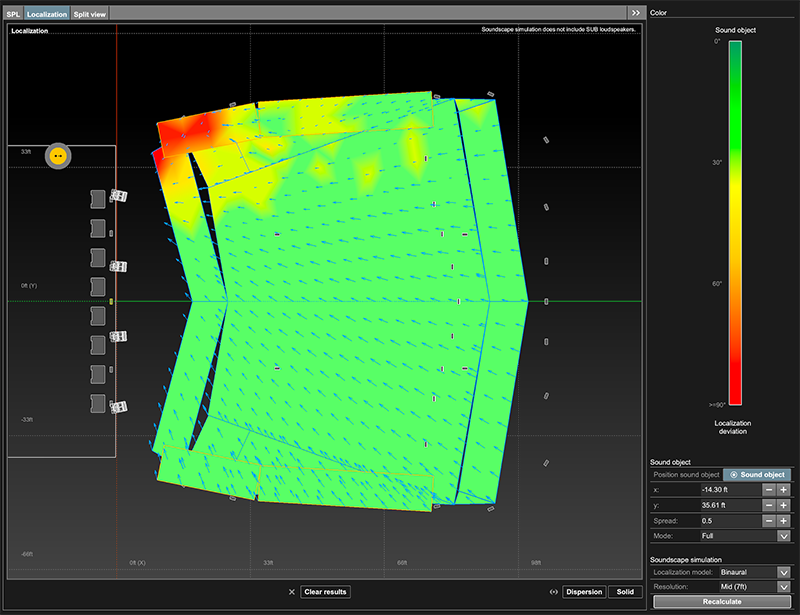
d&b Soundscape, En-Scene, localization heatmap © d&b audiotechnik GmbH & Co. KG.
This drawing from d&b illustrates the result: the vast majority of the house can realize from what side of the stage the source originates. Unlike traditional pure level-based panning, in its delay-based modes, d&b software coordinates both level and timing to establish time-based spatial relationships. To somewhat similar effect, L-ISA uses a frontal panning technique across five or more loudspeakers, while Meyer Sound’s Spacemap Go provides flexible maps for placing and moving sounds among spatially distributed loudspeakers.
Dolby Atmos offers another familiar example, particularly in cinema. In Atmos, individual sounds can be treated as objects, accompanied by metadata describing where they belong and how they move through three-dimensional space. A renderer translates those instructions for the particular playback system, distributing sound among the available loudspeakers, including those overhead. Our parcel can carry directions for recreating a whole sonic scene: a voice at the screen, footsteps behind us, a plane passing above.
There are countless ways to ship these parcels, each with its own possibilities and conditions. In my academic research, I equate this territory to The Wild West. Compared with the familiar conventions and laws of stereo panning, panning for spatial audio “gold” encompasses a fairly unruly family of approaches and responds to a landscape that itself is constantly evolving. A system’s usefulness depends on what we ask it to accomplish, how we arrange it, and the room we put it in.
What interests me most is the enduring inescapability of the subjective vantage. Even if we are able to expand—or eliminate—the sweet spot, we still hear from somewhere. If I sit to the left of the singer and you sit to the right, a convincing experience ought to preserve that relationship. We can agree about where the singer is while hearing her from different directions.
And once we begin to design for those different vantage points, what new worlds might we be able to build?
Room to Wander
A few years ago I created a performance-installation piece called Music for Earthlings that invited listeners to traverse mysterious, elevated pathways. It asks you to imagine nonhuman, subterranean perspectives, critters crawling underground. It plays with scale by creating a whisper-quiet environment made from magnified intimate sounds. Small, overlooked activity becomes something you can inhabit and investigate. The listener and the imagined creatures each follow their own paths. Wandering sonic paths establish relationships among sounds, but you encounter those relationships differently through your own position, movements, and attention. The piece takes shape where those paths meet; each listener’s encounter is a different, equally valid realization of a shared world.
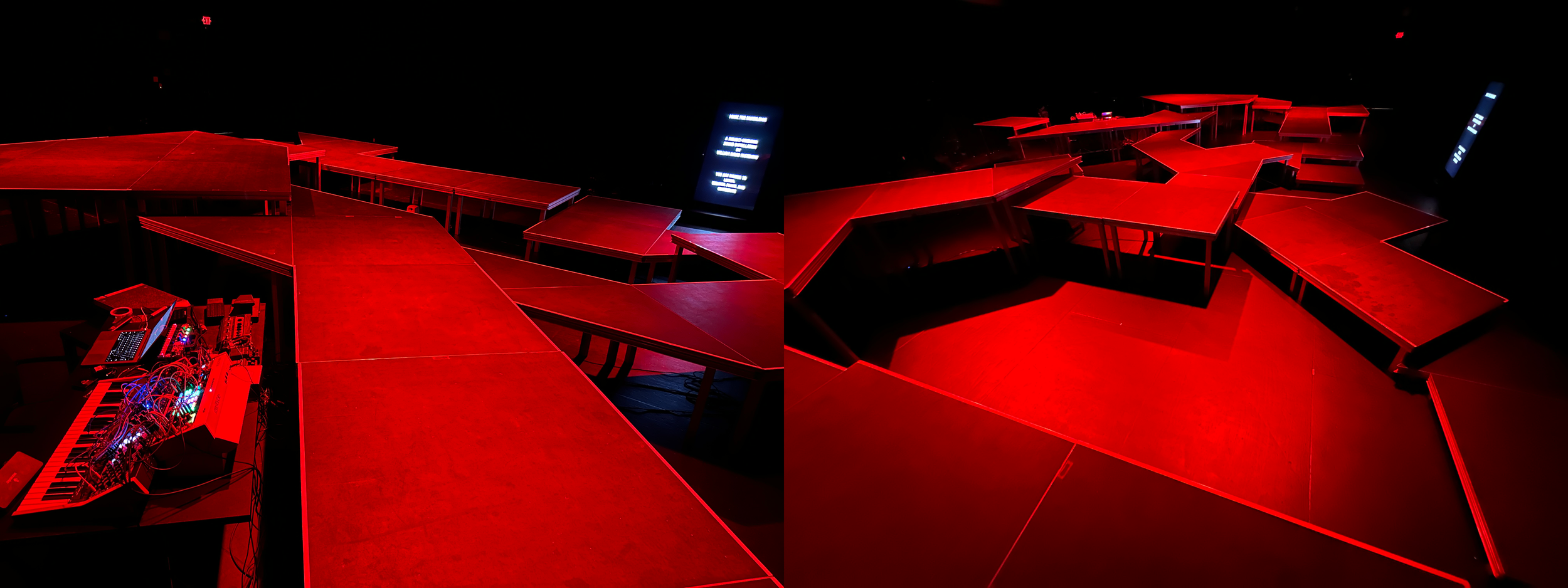
Performance-Installation Music for Earthlings by the Author © William David Fastenow
The system that this piece sets up invites me to exercise my agency as a listener. I can hear a sound “over there” and approach it. As I do, it gets louder. But, without moving an inch, I can also hear distant birds overhead, focus on them, and this also changes my experience. This phenomenon is called the cocktail party effect. Our brains have an incredible ability to isolate sounds based on how we focus our attention, whether that’s picking out some hot gossip from across the room at an ebullient soirée, or foregrounding the snake charmer as your boat floats down the worldly river.
What happens, then, when I compose with that agency in mind? I can give sounds relationships, paths, and a world to inhabit, while leaving room for listeners to find connections I haven’t prescribed. The work still asks something of me: those different encounters ought to have substance. But they needn’t be measured against a single, ideal version of the experience. Each can offer a way into the same world, and leave something there for someone else to find.
Floating the Boat
Back at It’s a Small World, the song is, unsurprisingly, still playing. My family gets in line again, wondering what we’ll see and hear this time.
Where we hear from includes the life we’ve lived. I could sit in the very same place I sat as a teenager and find myself somewhere else entirely. Our kids sit beside us, excitedly pointing out things my wife and I have long since stopped noticing. Through their discoveries, we find new ways to encounter this familiar little world. Their excitement becomes part of what the ride means to each of us now.
A boat, a room, a house—there is no best seat. Each of us brings something to the listening that no other seat could supply.